Make or Buy: Compare Only the Costs That Actually Change
A quote below your reported unit cost can still cost you more. How to separate avoidable costs and opportunity cost, find the indifference volume, and check what to ask before outsourcing.
In this article
An outside supplier quotes a price for a part or a service you now handle in-house, and the quote is clearly below the "unit cost" in your cost report. The decision looks easy. But that unit cost usually includes depreciation, rent and other allocated overhead, and most of those costs keep running after you stop making the part. A quote that looks cheaper can leave more cash going out of the business.
This article separates the costs you should compare from the ones that do not matter, works through an example where the answer flips twice, gives a formula for the volume at which making and buying cost the same, and ends with a checklist of what the numbers leave out before you sign with a supplier.
Compare only the costs that actually change
OpenStax's Principles of Accounting, Volume 2: Managerial Accounting sets out the rule for short-term decisions: information is relevant if it will influence the decision. A cost that is the same under every option does not affect the choice, so it does not belong in the comparison. The textbook defines four kinds of cost that apply directly here.
- Avoidable cost: eliminated in whole or in part by choosing one option over another, such as the materials for a part you stop making.
- Unavoidable cost: does not change in the short run whichever option you choose, such as the rent on the whole factory.
- Sunk cost: already incurred and cannot be recovered, so it is irrelevant to the decision, such as the price paid for a machine two years ago.
- Opportunity cost: the benefit you give up by not choosing the other option.
The textbook explains that the cost to make includes direct materials, direct labor, variable overhead and fixed overhead. If you buy instead, the avoidable costs go away but the unavoidable costs remain and must be counted as part of the cost to buy. In practice you can compare in two ways that give the same answer: total spending under each option, or only the costs that differ once the shared ones are removed.
Cost to make = variable cost per unit × volume + fixed costs you can stop if you stop making + opportunity cost of the space, machines and people
Cost to buy = (purchase price per unit + freight, inspection and defects per unit) × volume
A worked example where the answer flips twice
Illustrative example: a small wooden-furniture workshop turns 2,000 table legs a month for its own tables. The cost report puts a leg at 140 baht: 60 baht of materials, 30 baht of direct labor, 10 baht of variable overhead and 40 baht of allocated fixed overhead. A supplier offers the same leg for 115 baht. On the report, buying saves 25 baht a leg, or 50,000 baht a month.
The 40 baht of fixed overhead per leg is 80,000 baht a month, made up of three items: 30,000 baht of depreciation on the lathe (already bought, with no plan to sell it), a 35,000 baht share of factory rent (the workshop keeps the whole building) and a 15,000 baht maintenance contract on the lathe that can be canceled if turning stops. Assume direct labor is paid to daily-rate workers whose hours really can be cut. Buying adds 2 baht a leg for freight and inspection.
| Item | Make | Buy |
|---|---|---|
| Materials 60 × 2,000 | 120,000 | – |
| Direct labor 30 × 2,000 | 60,000 | – |
| Variable overhead 10 × 2,000 | 20,000 | – |
| Cancelable maintenance contract | 15,000 | – |
| Purchase price 115 × 2,000 | – | 230,000 |
| Freight and inspection 2 × 2,000 | – | 4,000 |
| Total costs that change | 215,000 | 234,000 |
| Opportunity cost: contribution from extra tables built in the freed space | 30,000 | – |
| Total including opportunity cost | 245,000 | 234,000 |
First flip. Remove the 30,000 baht of depreciation and the 35,000 baht of rent, which are paid either way, and making is 19,000 baht a month cheaper, not 50,000 baht more expensive as the report suggests. Total spending gives the same result: making costs 200,000 + 80,000 = 280,000 baht, buying costs 234,000 + 65,000 = 299,000 baht, a difference of 19,000 baht.
Second flip. If the workshop stops turning legs, it can use that space and those workers to assemble more tables, which it expects to earn 30,000 baht a month in contribution. That amount is the opportunity cost of making. Add it in and buying becomes 11,000 baht a month cheaper. Count an opportunity cost only when the extra work is really there and really sells. If the space would sit empty, the opportunity cost is zero.
The volume at which making and buying cost the same
Because some fixed costs can be stopped, the answer depends on volume. Making has a variable cost of 100 baht a leg and buying costs 117 baht a leg, so every leg made in-house saves 17 baht. Volume has to be large enough for those savings to cover the fixed costs of making.
Indifference volume = (fixed costs you can stop + opportunity cost) ÷ (cost to buy per unit − variable cost to make per unit)
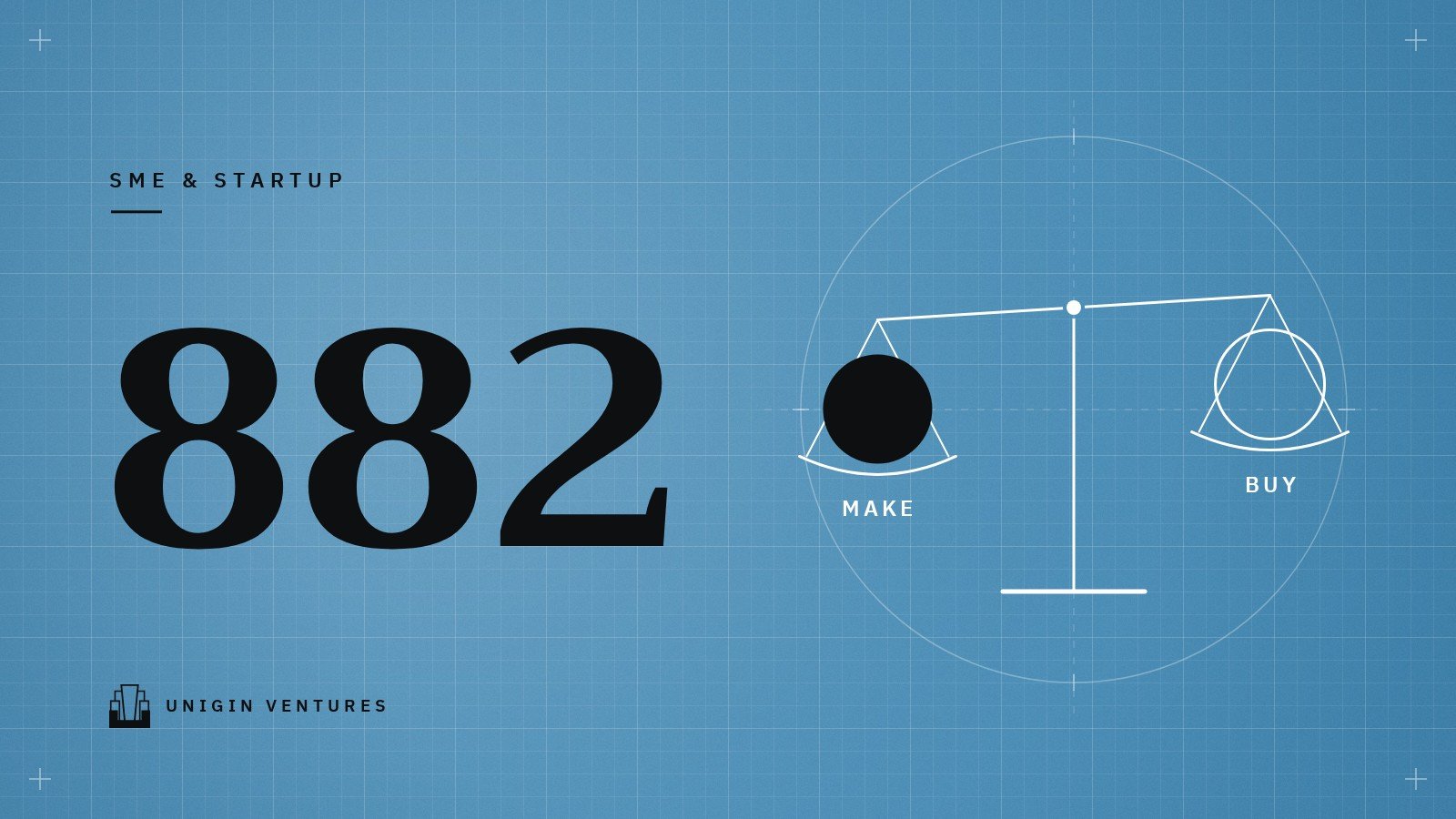
Without opportunity cost: 15,000 ÷ (117 − 100) = about 882 legs a month
With a 30,000 baht opportunity cost: 45,000 ÷ 17 = about 2,647 legs a month
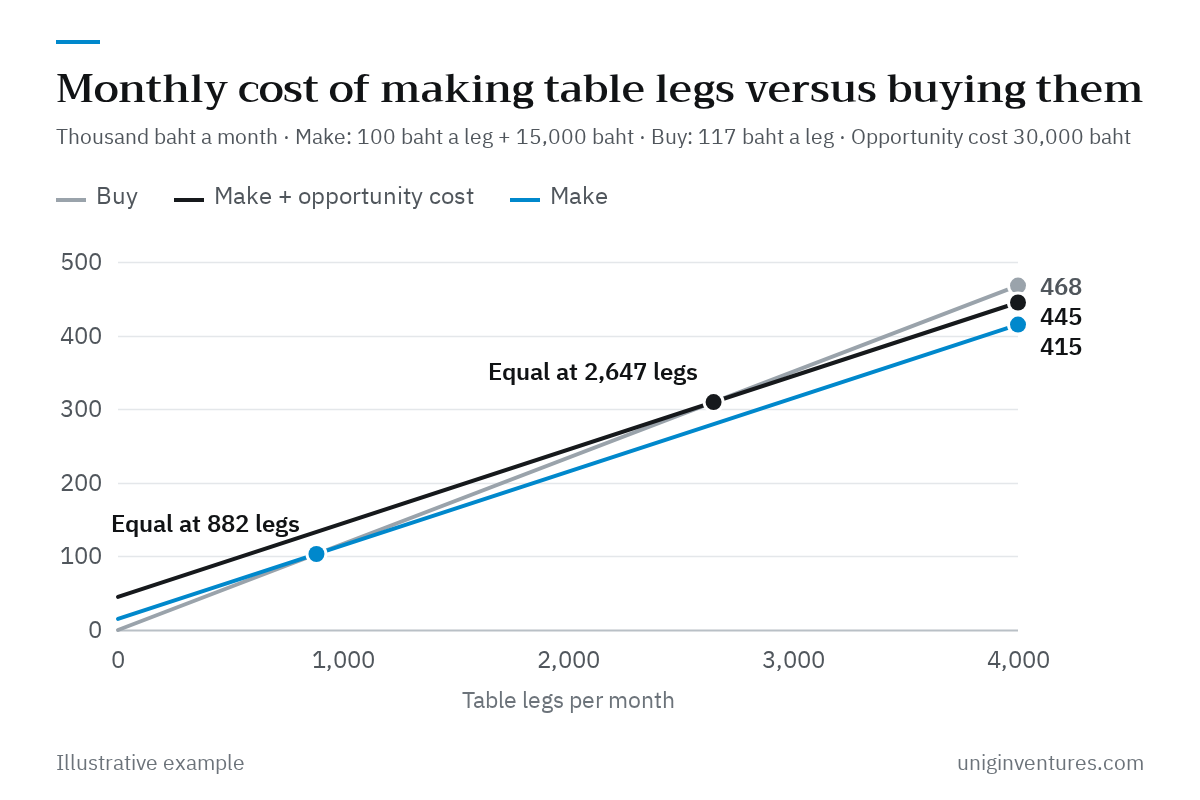
The formula holds when the purchase price and the variable cost per unit stay constant over the volumes you are looking at, and when your current capacity can handle that volume. If your expected volume sits close to the indifference point, a small forecasting error can change the answer, so run the numbers at lower and higher volumes as well.
The same logic applies to services
The make-or-buy question is not limited to factories. Service businesses face it when they choose between an in-house bookkeeper and an accounting firm, their own delivery vans and a courier, or an internal marketing team and an agency. The method is the same: go line by line and ask which costs really disappear if you outsource. The salary of someone who moves to other work does not disappear. Rent on an office floor you still fully occupy does not disappear. Freed-up staff time is worth something only when there is revenue-earning work waiting for it.
What the numbers leave out
OpenStax stresses that a make-or-buy decision should weigh all relevant costs together with qualitative issues, and it lists five questions, which turn into this checklist.
- Quality: does the supplier's part meet your standard? Ask for samples, try them on a real production batch before agreeing, and budget for defects in the cost to buy.
- Future price: is the quote an introductory price that will rise next year? Put the price adjustment terms and the period the price is fixed into the contract.
- Supplier capacity: can the supplier deliver the full quantity on time when your sales grow? Do you have a second supplier as a backup?
- Employees: if outsourcing leads to layoffs, statutory severance under the Labor Protection Act is a one-time cash cost (the rates are in provisions for retirement and severance pay), and the morale of the team that stays is affected too.
- Reputation: if the part is where customers notice quality, the supplier's mistakes become your brand's mistakes.
Two more questions are worth asking every time. First, if you stop making it and one day need to bring it back in-house, what will new machines and new people cost? Second, is this work part of the know-how that sets your product apart from competitors? Work that makes you different is often worth keeping in-house even at a slightly higher cost.
Where to start
- Pick one activity for which you have an outside quote, and split the unit cost in your report into variable cost and fixed overhead (if you do not have this figure yet, see unit product cost for small factories).
- Go through fixed overhead item by item and note next to each whether it stops if you stop making, and when it stops (some contracts require notice).
- Add the costs of buying that are not in the quote: freight, inspection, defects and the extra stock you must hold because of minimum order quantities.
- Write down what the freed space, machines and people will do and how much that will earn. If you cannot answer, set the opportunity cost to zero.
- Calculate the indifference volume, compare it with expected volume over the next one to two years, and only then go through the qualitative checklist before deciding.
The business, prices and figures in this article are illustrative examples. This article is general information, not financial advice for any particular business.