When a supplier statement disagrees with your books
Trace a ฿30,000 statement difference through invoices, payments and credits. Separate entries your team should post from timing items the counterparty must clear.
In this article
Your supplier’s statement says ฿180,000 is outstanding. The payables ledger says ฿150,000. Paying the lower amount might protect cash today, yet leave the team unable to explain what it has settled. Build a bridge from both balances to a common figure, with the supporting document and the next action on each line. That gives the payment approver something better than a choice between two screenshots.
A statement describes the counterparty’s records at a date. The individual supplier ledger describes yours. Agree on the legal entity, branches, currency and cut-off before opening invoices. A head-office statement covering three branches cannot be reconciled to one branch’s ledger by polishing invoice numbers.
Freeze the starting position
Ask for a statement showing document dates, references, movements and closing balance. Export the detailed supplier ledger for the same date and retain both original files. Mark the last items that reconciled in the previous month. If last month’s workbook contains unclosed differences, bring those lines forward individually so an old item cannot disappear into an opening balance.
Keep the original invoice reference and a separate standardized matching field. Removing spaces can help match two systems, but changing original references removes evidence. A payment sometimes covers six invoices and a credit. Show that allocation in a separate group under the transfer reference. Matching by amount alone can easily pair two identical monthly delivery charges with the wrong receipts.
Explain the gap from both sides
In this illustrative example, the supplier’s ฿180,000 includes a ฿20,000 invoice the buyer has verified but omitted from its ledger. It also includes a ฿2,000 credit the buyer has yet to post. Finally, the buyer has already recorded a ฿12,000 payment that cleared its bank before cut-off. The supplier’s statement does not yet show that receipt.
| Starting side | Reconciling item | Calculation in baht |
|---|---|---|
| Supplier | Deduct the payment in transit | 180,000 − 12,000 = 168,000 |
| Buyer | Add the missing invoice | 150,000 + 20,000 = 170,000 |
| Buyer | Deduct the missing credit | 170,000 − 2,000 = 168,000 |
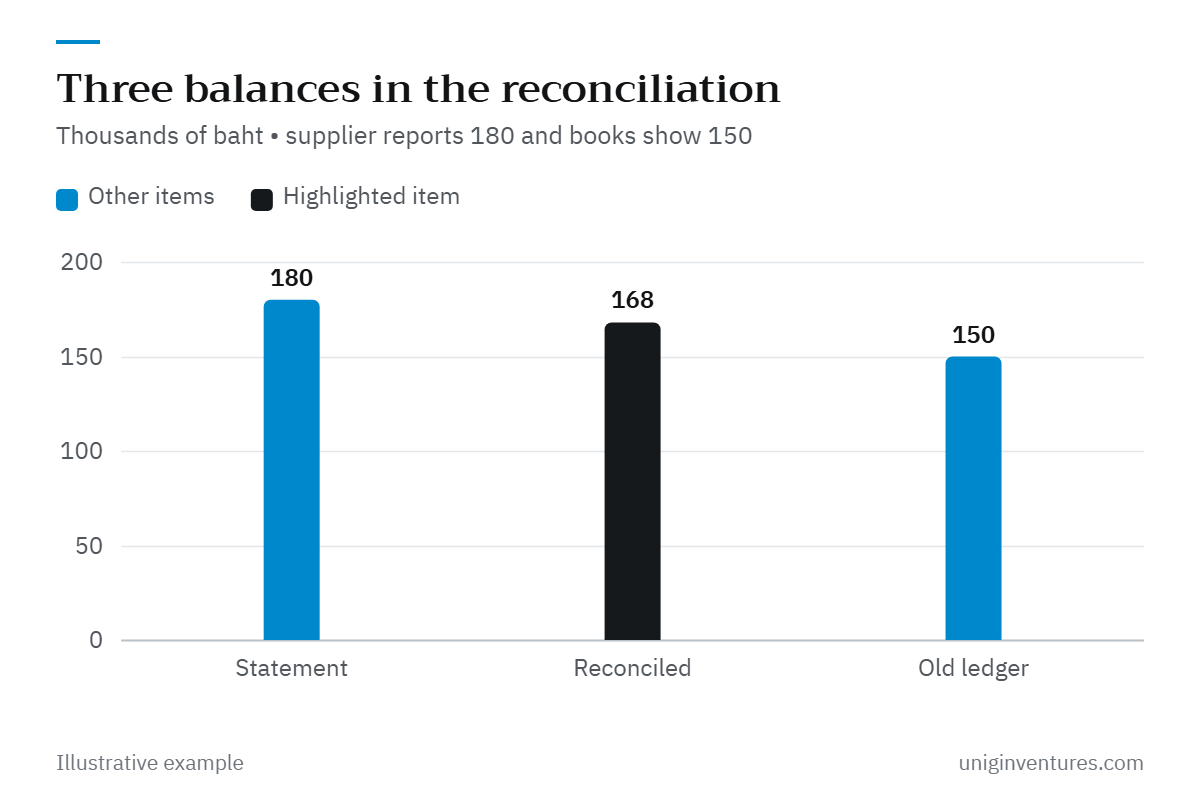
The ฿30,000 opening difference is fully explained by 12,000 + 20,000 − 2,000. Only ฿18,000 is a net change to the buyer’s books. Posting the whole ฿30,000 to expense and entering the real documents later would count part of the obligation twice. Keep the journal column separate from the column used to explain timing on the supplier’s side.
Assign each difference to its owner
Check the ฿20,000 invoice against the order, proof of receipt, price and proper recognition date. Being on a statement does not prove that goods reached the right branch. If delivery was disputed or the items were returned, record the dispute and ask for the missing evidence. Trace the ฿2,000 credit to the affected invoice. A credit issued for someone else’s return should never be used to reduce your payment.
For the ฿12,000 transfer, verify the date the bank actually debited the account, destination and reference. Provide remittance details using the agreed channel and look for the supplier’s matching receipt on the next statement. If the supplier applied cash to a different customer account, ask for the reallocation confirmation. A second posting to your cash ledger would leave the supplier’s error intact and introduce a new one at home.
Reverse the perspective when you are the seller
Start with your receivables detail and obtain the customer’s remittance or statement of open invoices. An invoice the customer has not approved may be missing signed delivery evidence. The salesperson can secure that evidence while receivables searches for money the customer claims to have sent. Check the bank before marking an invoice paid.
When the payment is short, ask what makes up the difference. A commercial return, agreed credit, withholding certificate and disputed quality claim can all produce the same net deposit. They require different evidence and can belong to different owners. Give each unresolved line a next contact and due date. A salesperson offering an extra discount cannot resolve cash that was simply assigned to the wrong invoice.
Look for equal balances hiding the wrong invoices
Suppose a supplier has two invoices for THB 12,000 each, delivered to different branches. Your system recorded the first invoice twice and missed the second. Both ledgers can total 24,000 while one branch is about to pay twice and the other cannot locate its invoice. Request open items individually and compare invoice sequence, receiving reference, destination and amount outstanding. A zero difference at the foot of the statement does not resolve this case.
If the supplier applied a bank transfer of 12,000 to an unallocated account, send a remittance advice identifying the intended invoice and ask for the post-allocation listing. Leave a named confirmation item open. A duplicate posting understates cash in the ledger. Sending a second transfer would also pay the supplier twice. Have someone outside payment preparation check that the supplier cleared the intended item and that the remaining invoice still appears on the correct due date.
Start the next reconciliation with the open branch and receiving references. Looking only at a fresh pair of totals can leave offsetting mistakes unresolved for months. Once corrected, the same records explain the shipment to purchasing, the expense to accounting and the one remaining payment to treasury.
Close the month with an audit trail
Retain both original reports, the bridge, posted adjustment references and unresolved timing items. Date the prepared and reviewed copies. If the parties agree to pay the undisputed portion while investigating a delivery, the approver should list the invoices being paid and deduct amounts already transferred. The common ledger balance is a reconciliation result, not a blanket payment instruction.
Start next month with the unresolved lines. If the supplier now shows the ฿12,000 receipt, close the item against that receipt reference. If it remains outstanding beyond the normal processing cycle, verify the receiving account and allocation before releasing another payment. A useful dashboard measures the age and evidence behind open differences. An apparently tidy zero produced by netting several unrelated disputes tells the owner very little about the risk still on the account.